How practice works
From a reusable preset to a candidate who is genuinely ready.
Build from a preset
Start from your preset library or a job description. Set the interview types, question banks, evaluation criteria and tone once, then reuse them for every comparable role.
Frontend Developer
Role requirements mapped
Evaluation criteria
Custom scoring rubric set
Assign with a deadline
Invite candidates from the workspace and set a deadline. Reminders go out automatically three days before and on the day itself, so nobody has to be chased.
Invite candidate
Send a practice link
Warm up, then practise
Candidates start with a five-minute practice round that stays entirely private. After that they work through the interview steps you configured, unlocking each one by meeting the score and duration you set.
Tell me about a time you led a cross-functional project.
At my last role, I coordinated between engineering and design to ship a new onboarding flow...
Interesting. What was the biggest disagreement, and how did you resolve it?
The design team wanted a 5-step wizard, but engineering pushed back on scope...
How did that outcome influence your approach to stakeholder alignment?
Feedback, then a retake
Every session produces a private report: an overall score, a six-criterion scorecard, an assessment of each answer and the full transcript. Candidates can retake the same interview, or an adaptive one aimed at their weakest criteria.
Overall score
Top 15% of candidates
Key improvement: Provide more specific metrics when discussing project outcomes.
See readiness, not transcripts
Your Conversations and Candidates views show who practised, how often and how they scored. Transcripts shared with reviewers have direct identifiers removed, and candidates control what is shared at all.
Preparation score
ReadyHow practice works
Build from a preset
Start from your preset library or a job description. Set the interview types, question banks, evaluation criteria and tone once, then reuse them for every comparable role.
Assign with a deadline
Invite candidates from the workspace and set a deadline. Reminders go out automatically three days before and on the day itself, so nobody has to be chased.
Warm up, then practise
Candidates start with a five-minute practice round that stays entirely private. After that they work through the interview steps you configured, unlocking each one by meeting the score and duration you set.
Feedback, then a retake
Every session produces a private report: an overall score, a six-criterion scorecard, an assessment of each answer and the full transcript. Candidates can retake the same interview, or an adaptive one aimed at their weakest criteria.
See readiness, not transcripts
Your Conversations and Candidates views show who practised, how often and how they scored. Transcripts shared with reviewers have direct identifiers removed, and candidates control what is shared at all.
Frontend Developer
Role requirements mapped
Evaluation criteria
Custom scoring rubric set
Invite candidate
Send a practice link
Tell me about a time you led a cross-functional project.
At my last role, I coordinated between engineering and design to ship a new onboarding flow...
Interesting. What was the biggest disagreement, and how did you resolve it?
The design team wanted a 5-step wizard, but engineering pushed back on scope...
How did that outcome influence your approach to stakeholder alignment?
Overall score
Top 15% of candidates
Key improvement: Provide more specific metrics when discussing project outcomes.
Preparation score
ReadyShift the focus from nerves to potential
See how preppito transforms the traditional hiring timeline by empowering candidates to perform at their best, giving you a clearer signal.
Generic resources
Recruiters send standard invites with generic 'how to prepare' PDFs or links to company blogs.
Tailored to the role
A practice interview is prepared for each candidate, tailored to the specific role and their CV.
Manual & unscalable
All preparation is manual — recruiters spend 30+ minutes per candidate, or candidates are left to practise alone.
Unlimited self-practice
Candidates practise on their own as often as they need and get instant, actionable feedback.
Generic check-in
Any remaining prep time goes to the basics, with little insight into where a candidate actually struggles.
Focused & targeted
With self-practice done, the recruiter's final prep talk is short and aimed at the candidate's specific weak spots.
Rehearsed answers only
Candidates aren't prepared for a real conversation and can only fall back on the default questions they rehearsed.
Testing true potential
Candidates arrive confident. Hiring managers have deep, high-value conversations focused on true technical and cultural fit.
High false-negative rate
Great talent slips through the cracks due to interview anxiety. The hiring process drags on, costing time and money.
Clear signal-to-noise
Clear signal. Faster hiring decisions, higher offer acceptance, and a noticeably better candidate experience.
Supercharge your candidate preparation
You handle the sourcing and screening. We make sure your candidates are truly ready for the actual interview.
Preppito scales your preparation process. Instead of manual mock interviews, candidates practice with realistic AI simulations, while recruiters use the detailed feedback to guide their final prep talks.
The result? A more productive hiring process, a standardized baseline for all candidates, and significantly higher placement rates.
“Empower your recruiters to help more candidates at once, turning good profiles into great interviews.”
Conversations that feel real
Give candidates the closest thing to sitting across from a real hiring manager.
Realistic voice models
Ultra-low latency voices that interrupt, react and sound completely human.
Real-time adaptation
The AI listens to the answer and branches the conversation, rather than reading down a script.
Instant feedback
A detailed report within minutes: overall score, six-criterion scorecard and an assessment of every answer.
Room to run over
Candidates can extend a session three times by five minutes when a conversation is going somewhere, and always see how much time is left.
English and Dutch
The same interview configuration runs in either language, with a voice to match.
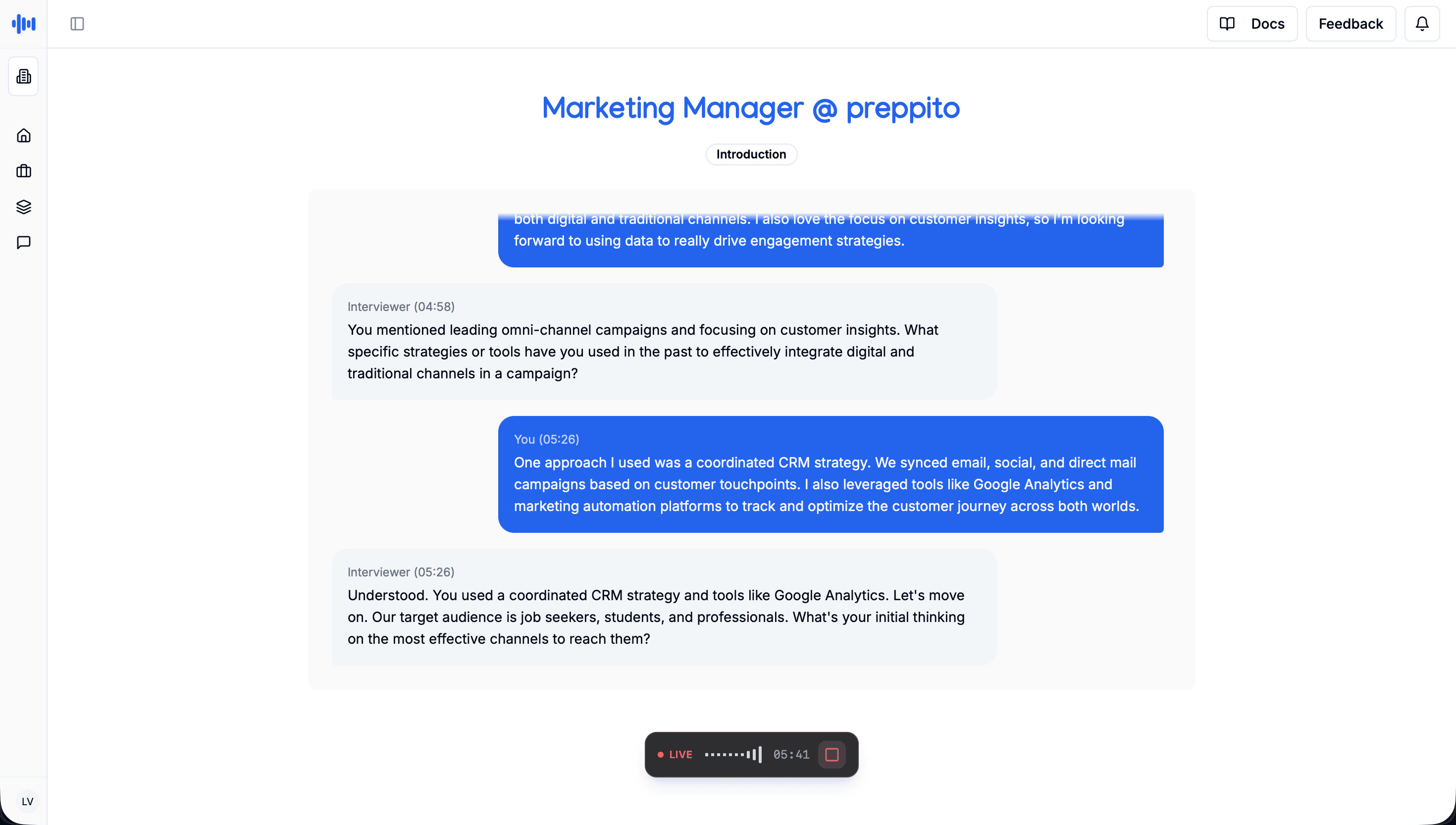
Tell me about a time you led a cross-functional project.
At my last role, I coordinated between engineering and design to ship a new onboarding flow...
Interesting. What was the biggest disagreement, and how did you resolve it?
The design team wanted a 5-step wizard, but engineering pushed back on scope...
How did that outcome influence your approach to stakeholder alignment?
Reusable interview presets
Configure interview types, question banks, criteria and tone once, then reuse them across every comparable role.
Multi-step interview paths
Chain interviews into a process and gate each step behind a minimum score and duration, so candidates progress only when they are ready.
Workspaces and roles
Separate workspaces per team, with owner, admin and candidate roles and invitations you control.
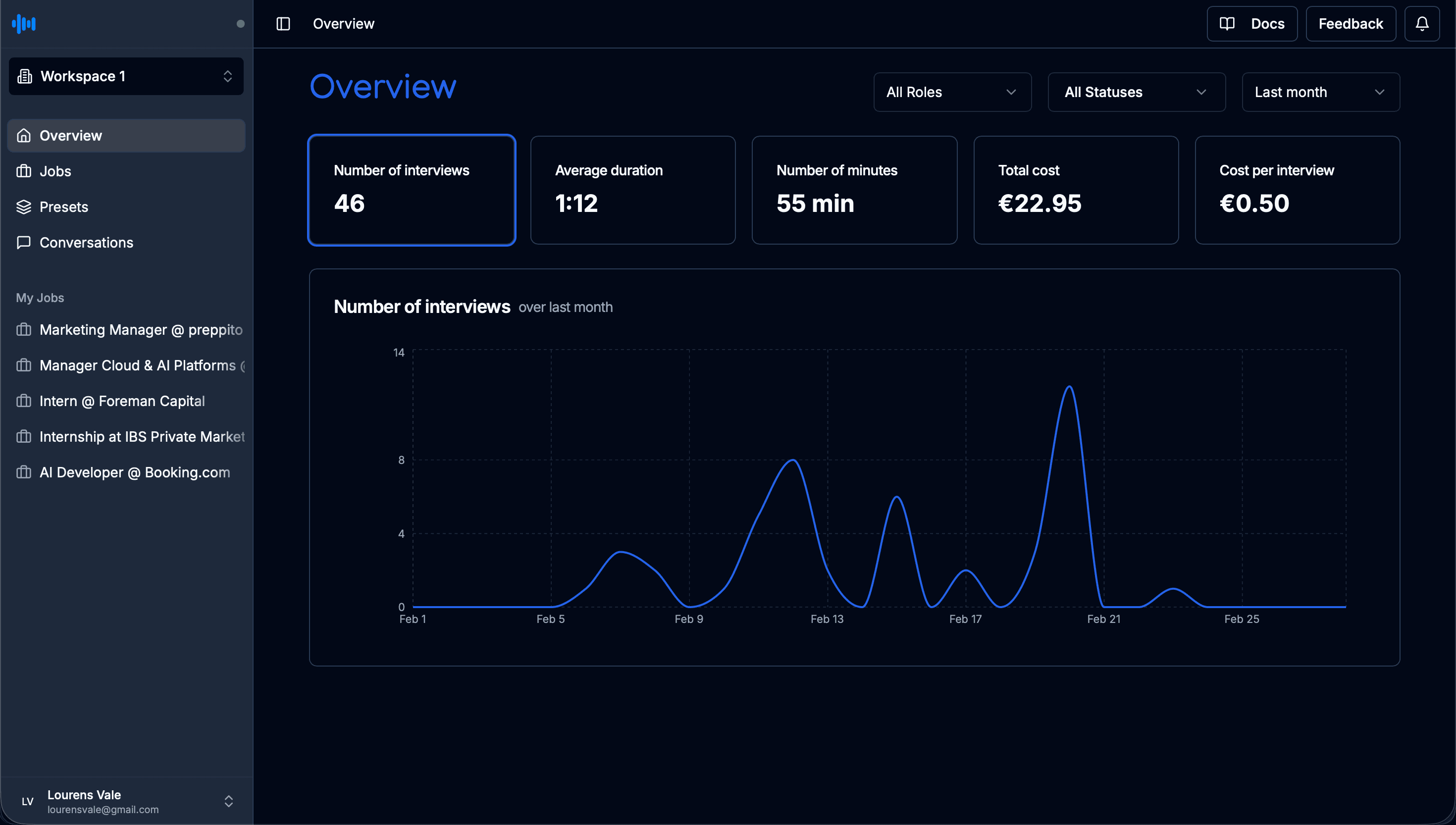
Readiness analytics
Track participation, scores and activity across a workspace, filtered by role, status and date range.
Deadlines and reminders
Set a deadline per job or per candidate. Reminders are sent automatically and overdue work is flagged on the jobs board.
Budgets and usage limits
Set a monthly workspace budget and per-candidate allowances, with alerts before you reach the threshold.
EU data residency
Interviews and reports are processed in the EU, and your job descriptions, criteria and candidate data are never used to train foundation models.
Consent and GDPR controls
Candidates consent per organisation and can withdraw. CVs are stripped of direct identifiers, reviewer transcripts are redacted, and data is deleted on a published retention schedule.
Scale your hiring with confidence
Custom packages designed for recruiting teams.
Frequently asked questions
Everything you need to know before getting started.